
What RTP Tells You—and What It Does Not
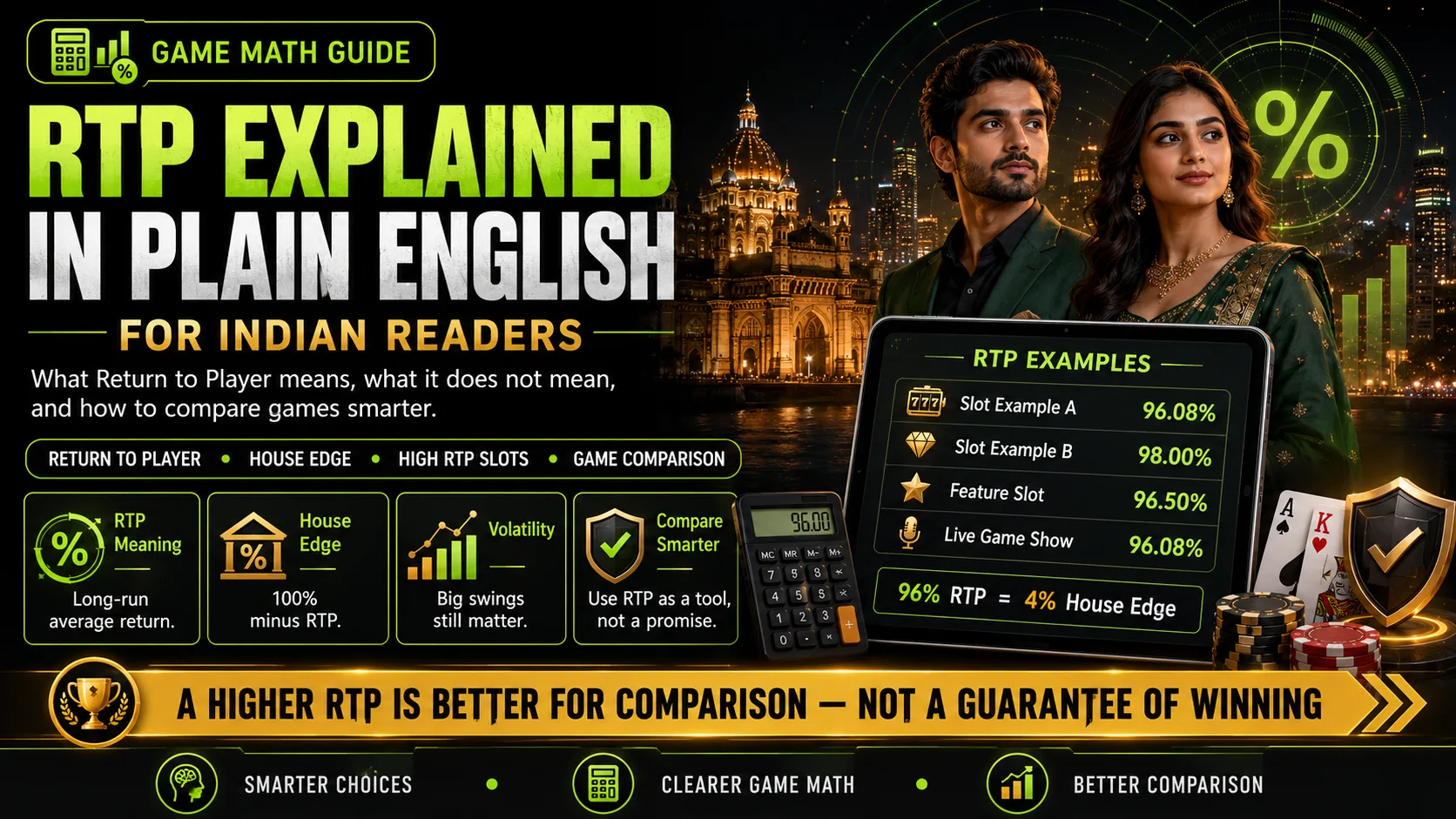
RTP means Return to Player: the percentage a game is designed to return across a very large sample of wagers. It belongs to a long-run model, not to the next spin, the next hour or one person's account. Use it to compare game versions, never as a promise of what you will receive.
Turning RTP into House Edge
Subtract RTP from 100% to find the theoretical house edge. A 96% game therefore has a 4% long-run operator advantage. Higher RTP generally means a smaller mathematical edge, but it does not remove randomness or make the game profitable.
- A 95% RTP corresponds to a 5% house edge
- A 96% RTP corresponds to a 4% house edge
- A 98% RTP corresponds to a 2% house edge
Why Your Next ₹1,000 Will Not Follow the Percentage
Playing ₹1,000 on a 96% title does not entitle you to ₹960 back. Over a short run, variance dominates the average. One person might finish quickly with nothing, while someone else could trigger a feature on the first few rounds. Both results can occur within a game whose theoretical return is exactly the same.
Return and Volatility Measure Different Things
RTP looks at the average amount returned over an enormous number of rounds. Volatility describes the pattern of those returns. Two slots may publish nearly identical RTP figures yet feel unrelated: one can award modest wins fairly often, while the other may have long quiet periods interrupted by much larger swings.
Other Details Worth Checking
- How often winning combinations appear
- The maximum win and how bonus features work
- Rules used by a table or game-show title
- The RTP displayed inside the exact version you opened
- Whether the provider supplies several RTP configurations
Five Myths to Leave Behind
A cold slot does not owe the next player, and a recent win does not block another. Bonus rounds are already part of the model, while stake patterns cannot control the random-number generator. Even a high-RTP game can consume the full session budget.
Using RTP Responsibly
For readers in India, the percentage is most useful when comparing similar games. It cannot settle questions about local law, remove the chance of financial harm or tell you whether a session will be enjoyable. Set a spending limit first, then use RTP as one piece of information rather than a strategy.
Quick Questions
1. What does RTP stand for? Return to Player, a theoretical long-term return across many rounds.
2. Is volatility another word for RTP? No. Volatility describes the size and frequency of swings, not the average return.
3. Does a high RTP guarantee a win? No. It cannot promise any individual result.
4. Can one slot have several RTP values? Yes. Providers sometimes offer different configurations, so check the in-game help screen.
5. Can RTP be used as a betting system? No. It is useful for comparison, not prediction.